Satellite launched in 2018 travelled over 10 billion kilometres past nine planets towards Mercury
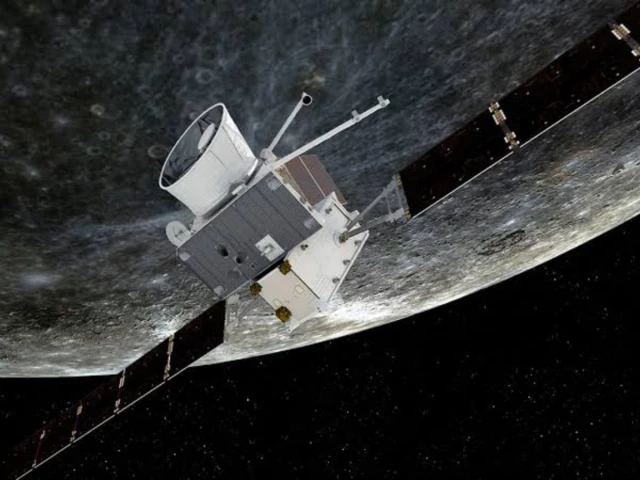
The BepiColombo spacecraft is set to make a close pass to Mercury, shown here in an artist’s conception, on 4 September. Researchers will use the encounter to test instruments and study the interaction between solar wind and the planet’s magnetic field. PHOTO: ESA
After an eight-year-long trek through outer space, the Japanese-European joint BepiColombo probe has entered Mercury’s orbit, the European Space Agency (ESA) said on Sunday.
On X, the ESA said that BepiColombo “achieved orbital capture” around the smallest and least understood planet in the Solar System after turning on the thrusters for more than half an hour.
The probe was already analysing the data it had collected, the agency added.
Launched in 2018, the four-tonne satellite had already crossed more than 10 billion kilometres and nine other planets en route to the closest planet to our Sun.
Earlier this year, ESA mission chief Santa Martinez told AFP that the mission was set to “offer humanity never-before-seen views of Mercury and open a new chapter in our understanding of the Solar System”.
The European and Japanese portions of the probe are set to split from each other and go along their respective orbits on December 9 and 10, according to the mission plan.
The European portion is set to study the planet’s surface, skimming just 480 kilometres (300 miles) above Mercury.
The Japanese part, meanwhile, will follow an elliptical orbit that will take it as far as 11,000 kilometres from the planet in a bid to learn more about Mercury’s magnetic field.
Swinging between temperatures hitting as low as -180C and as high as 450C, Mercury is frequently bombarded by intense radiation from our Sun.
In 1974, NASA’s Mariner 10 probe became the first to fly past the planet.