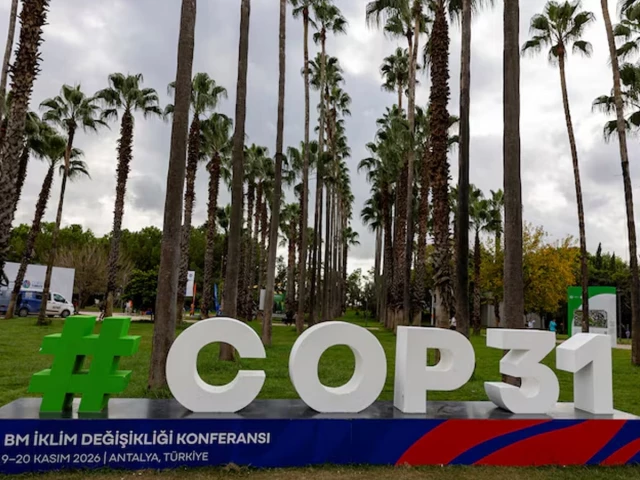
A COP31 sign is displayed at the venue of the United Nations Climate Change Conference (COP31) in Antalya, Turkey, November 19, 2026. Photo: Reuters
ANTALYA:
The UN climate conference ended without an overarching political agreement on Sunday after negotiations dragged into overtime, as countries failed to bridge deep divisions over transitioning away from fossil fuels and delivering firm climate-finance support for developing nations. The final draft dropped any mention of moving away from fossil fuels, a red line for the European Union and several climate-vulnerable countries but opposed by oil producers, including Saudi Arabia and Russia. The conference ended without adopting the proposed Antalya Pact, marking a major breakdown in UN climate negotiations.
The central dispute was over whether the final text would name fossil fuels directly. A coalition of countries pushing for greater climate ambition, led by the European Union, Panama, the Marshall Islands and Norway, refused to endorse a deal that did not explicitly commit to transitioning away from coal, oil and gas. They argued that any meaningful agreement must address the root cause of the climate crisis. Oil-producing nations, notably Saudi Arabia and Russia, pushed back against language singling out fossil fuels, favouring instead an indirect reference to previous agreements. The final draft omitted the phrase entirely, a significant retreat from an earlier version that had called for an “immediate transition away from fossil fuels”. It also fell short of the landmark COP28 pledge in Dubai in 2023, when countries agreed for the first time to call for a transition away from fossil fuels.
The second major fault line was climate finance, where developing and climate-vulnerable countries demanded greater support for adaptation. An earlier draft called for tripling adaptation finance by 2035, but critics said the proposal lacked baseline figures and specific funding commitments, leaving many developing nations deeply disappointed. Those least responsible for emissions and most exposed to climate impacts were once again left without credible assurances of financial support.
The breakdown came against a dire scientific backdrop. A recent UN report put the world on course for potentially catastrophic warming of 2.8°C under current policies, far beyond the Paris Agreement’s 1.5°C target. While the failure to produce a new political declaration was a significant blow, it did not erase the legal and technical obligations agreed at previous UN climate conferences.
The failure drew sharp reactions from negotiators and observers. Ireland’s climate minister, Darragh O’Brien, speaking for the EU presidency, said the talks had been “hijacked by some oil states”. Australia’s Climate Minister Chris Bowen, whose country co-presided over the summit with Türkiye, called the outcome “very disappointing” but pointed to side pledges, including a commitment by more than 90 countries to ramp up electrification. UN Secretary-General António Guterres said he was “deeply disappointed” and “frustrated”.
Campaign groups were blunter still, directing their criticism both at oil producers for blocking fossil-fuel language and at wealthy nations for retreating on finance. Tasneem Essop, Executive Director of Climate Action Network International, called it “the worst COP ever”, saying “rich nations gutted the very measures that could have made a difference”. Pointing to EU Climate Commissioner Wopke Hoekstra’s pre-summit declaration that discussions on new climate finance were “dead in the water”, she said the EU’s rejection of a text silent on fossil fuels was “the height of hypocrisy. Deeds not words is what matters.” The space to protect humanity from climate catastrophe, she said, “is being deliberately dismantled by political leaders who consider the lives of those in the global south as disposable”.
Teresa Anderson, Global Lead on Climate Justice at ActionAid International, warned that “temperatures are rising, impacts are rising, but support for climate-hit countries is shrinking”. The EU’s refusal to allow real progress on adaptation finance, she said, meant “harvests will fail when they might have thrived” and “people will drown because they didn’t get a flood alert”. While the EU’s stand against a weak fossil-fuel text had helped its reputation, she argued that “its self-appointed crown of climate leadership still sits crookedly”.
Harjeet Singh, Strategic Advisor to the Fossil Fuel Treaty Initiative and Global Convenor of the Fill the Fund campaign, said the text failed on every major front. A reference to the COP28 outcome was not enough, he said, arguing that countries needed a concrete plan to move away from fossil fuels that was “fair, fast and funded”. He accused wealthy nations of removing financial accountability from the negotiations, saying they had “forced the deletion of every number that would show whether they have” paid and “even erased the word ‘debt’ from a finance decision”, despite countries across Asia and Africa spending more on debt repayments than on protecting their people.
Climate and human rights campaigner Kumi Naidoo argued that a bad text would have been worse than none. “Sometimes, no deal is better than a disastrously bad deal”, particularly one “with no meaningful climate finance, no mention of the elephant in the room, fossil fuels, and, worse still, a renewed embrace of technological distractions and false solutions like carbon capture and storage”, he said.
For activists from the Global South, the failure was felt as something more personal. Prayash Adhikari, a climate justice activist with the People’s Movement for Climate Justice Nepal, said the world had “once again prioritized the powerful and ignored the voiceless, dismissing the grievances and appeals of the Global South”. For his community, “this COP was not just another event; it was a source of hope” that the world would finally uphold accountability and justice. Instead, he said, “this is a complete betrayal and erasure of millions of lives in Nepal and across the Global South”.