Malik says Pakistan open to evidence-based discussions, stresses dialogue does not mean compromising stances
ISLAMABAD’:
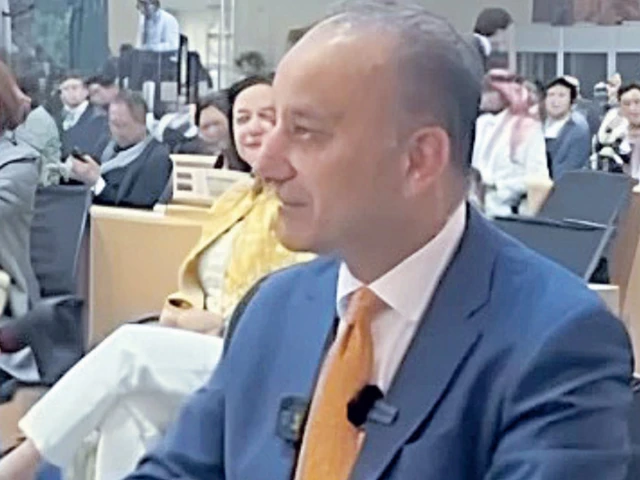
Federal Minister for Climate Change Dr Musadik Malik has urged India to pursue dialogue rather than provocation to resolve outstanding issues, saying Pakistan remains open to engagement on terrorism and the Indus Waters Treaty without compromising its stated positions.
Speaking to senior journalists at the Pakistan High Commission in New Delhi, according to Express News, Malik said a lasting solution to terrorism required meaningful dialogue based on evidence. He assured that discussions on the issue could take place, stressing that allegations alone could not resolve the problem.
“All discussions on terrorism will be based on evidence,” he told the journalists, adding that evidence could be presented at bilateral or multilateral forums. “You present your evidence, and we will put forward ours,” the minister added.
Malik said Pakistan wanted a transparent mechanism through which both sides could present their respective evidence rather than use allegations for propaganda. He maintained that dialogue did not mean agreement or a retreat from either country’s position.
Meanwhile, in an exclusive interview with PTV Digital’s Ayesha Mir in New Delhi, Malik said Pakistan wanted discussions at the Shanghai Cooperation Organisation (SCO) to focus on regional cooperation and issues within the forum’s mandate rather than bilateral tensions.
He confirmed that Islamabad had invited all SCO member states, including India, to its upcoming events, as Pakistan holds the chairmanship of the SCO Council of Heads of State for 2026-27.
Malik described the invitation as an expression of reciprocity, noting that India had invited Pakistan to the inaugural SCO Civilizational Dialogue Forum in New Delhi. “Why would we not invite all of the members of SCO? Our invitation is squarely to all members without an exception,” he said.
He said Pakistan had firm positions on issues including terrorism and the Indus Waters Treaty but remained open to discussions if the other side demonstrated sincerity. “Dialogue doesn’t mean we are agreeing. Dialogue also doesn’t mean either of the parties is relenting from its point of view,” he said, adding that communication could strengthen relations despite differences.
On the Indus Waters Treaty, Malik said Pakistan had not received any invitation for talks at present. However, he said Islamabad would certainly engage if such an invitation was extended.
Reflecting on his engagements with regional representatives, the minister said discussions with counterparts from Iran, Nepal, Azerbaijan, Kyrgyzstan and Tajikistan had highlighted shared concerns over conflicts and natural disasters, alongside common cultural traditions and regional identities.
Explaining his decision to deliver his address at the forum in Urdu, Malik said its focus on civilisation and culture had prompted him to speak in his own language. “I wanted to speak from my heart,” the minister said.
“It was about my identity. It was about our identity, the identity of Pakistanis and also our regional identities,” he said, adding that it was important to speak in his own voice when discussing civilisation and culture.
Malik led Pakistan’s delegation to the inaugural SCO Civilizational Dialogue Forum, where he proposed a three-part framework for cultural cooperation, including a network of cultural institutions, a shared digital repository and a climate-resilient heritage framework.