PUBLISHED
November 29, 2026
There was a time when stepping out of the house did not require quite so much emotional preparation. A trip to the post office, a visit to the supermarket or an evening at the cinema was simply that, the latter actually quite joyous. An errand, a bit of shopping or an outing generally made one happy to be doing so. Today, however, even the most ordinary excursion can test one’s patience, largely because of the people one encounters along the way.
I have increasingly found myself reluctant to be in both large and small crowds. I want to completely escape them. I love early morning breakfast meet-ups as opposed to dinners at noisy, crowded restaurants, where children are free to create a sugar-fuelled mayhem. It is not necessarily the noise, the congestion or even the occasional jostling that bothers me. It is the apparent absence of consideration for anyone else. Somewhere along the way, the simple understanding that we share public spaces seems to have been replaced by the belief that everyone else should simply accommodate us.
Of course, there are occasions when one goes out with expectations firmly adjusted. A packed concert, a cricket match, a wedding or a crowded festival is hardly the place to expect everyone to behave as though they are attending a formal dinner. There will be noise, pushing, excitement and the occasional person who seems to have mistaken the occasion for a personal performance. One learns to make allowances.
But why should the same allowances be necessary when buying groceries, getting into a lift or trying to walk through a restaurant, a mall or a clothes store?
Consider the humble queue. It is a fairly straightforward arrangement: the person who arrives first is served first. Yet, in our part of the world, queuing can sometimes appear to be an exercise in creative positioning. I was shocked to see a white shalwar-kameez clad middle-aged man, with the high-brow air of a feudal or an MPA-MNA, walk over to a shop assistant in a premiere grocery store and tip her generously. She took his loaded basket from him, and a few packages from his arm, went up to the checkout and get his stuff done, completely ignoring the queue. Seriously? Could her have done this abroad?
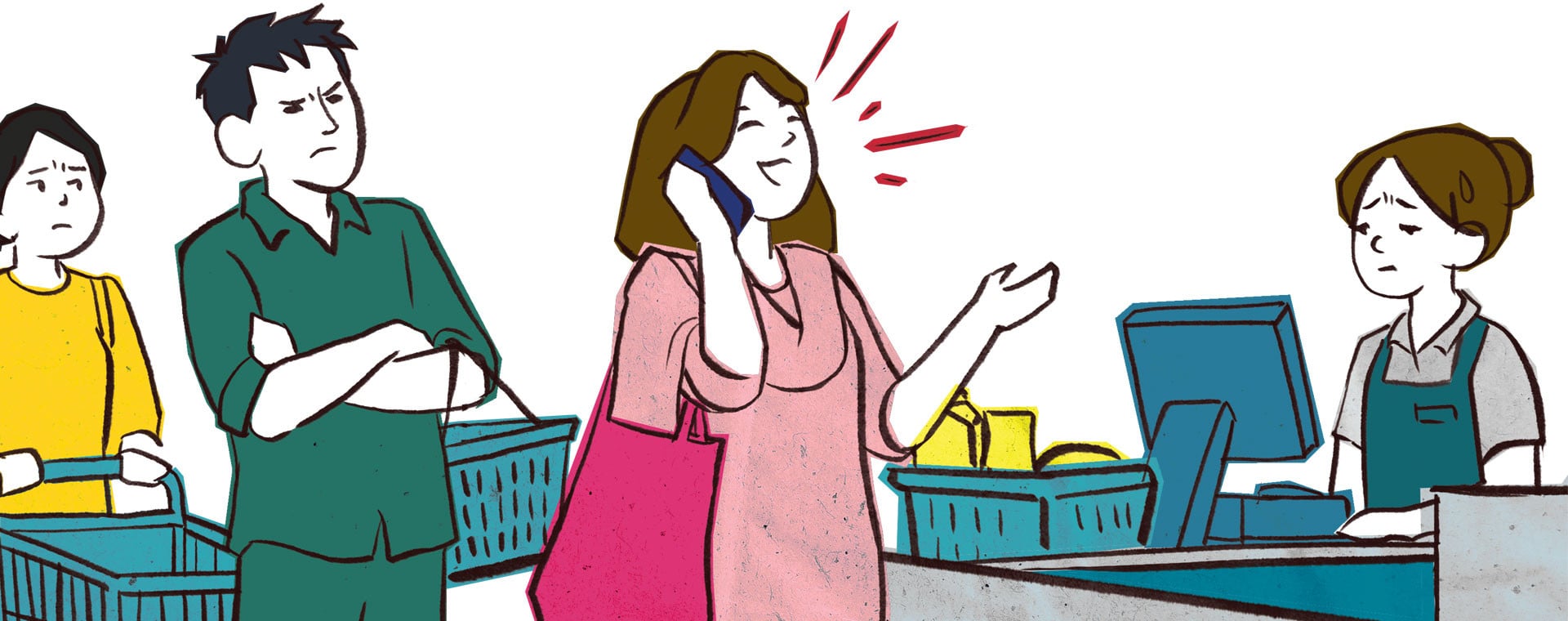
At other times, someone will quietly edge forward, another will squeeze into the smallest available gap, while a third will announce that they are only asking a question. Before long, the queue has become a loose gathering of people, each convinced that their business is more urgent than everyone else’s.
There is also the familiar individual who arrives with an entire family, apparently believing that one person’s place in the queue can be converted into a collective entitlement. And if someone objects, the offended expression suggests that the person asking them to wait has committed a serious social transgression.
In traffic, on the roads, we see an even more elaborate demonstration of our relationship with common courtesy. An indicator, for instance, is supposed to signal an intention to change lanes. It is not a confession of weakness or an invitation for the driver behind to accelerate and close the gap. Yet, the moment one indicates, a bully will often make it their personal mission to prevent the manoeuvre. A little patience would allow another vehicle to move safely. Instead, there is hooting, flashing headlights and, occasionally, a display of temper that suggests a matter of national importance is at stake.
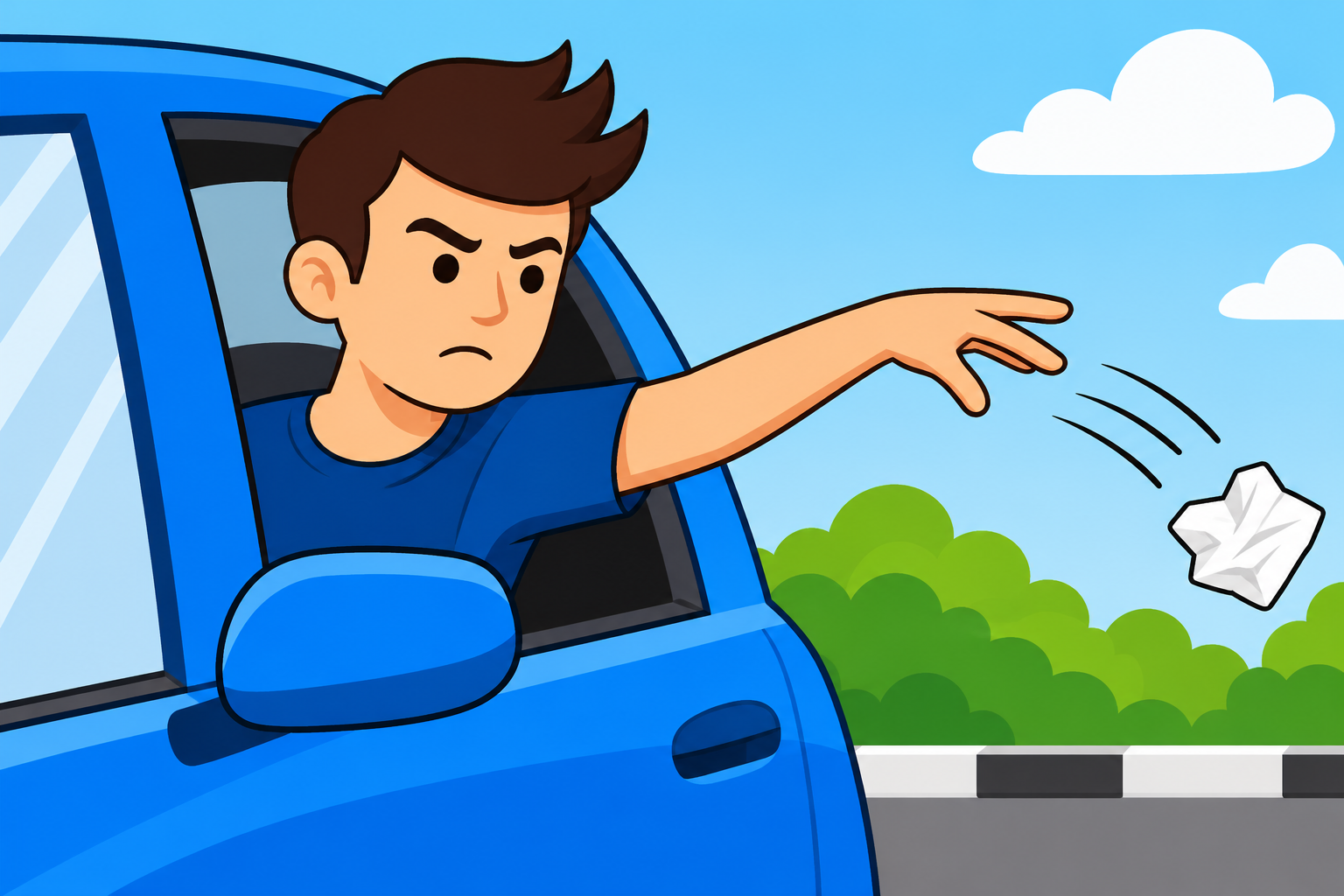
Then there are those who park wherever they please, regardless of whether they are blocking a driveway, a narrow road or the entrance to a shop. A convenient spot is a convenient spot, apparently, even if it inconveniences twenty other people. The hazard lights are switched on, as though this magical device grants temporary immunity from parking rules. Begum Sahibs who cannot make up their mind at which shop to get off, will boggle their chauffeur and the poor driver behind as they slow down, get ready to park, reverse and move slowly again until madam has finally made up her mind if she wants to get her dupatta dyed first or stop at the tailor’s.
The same attitude extends to pavements. Walking along one can be an exercise in negotiation, particularly when a group decides to occupy the entire width, moving at a leisurely pace, munching French fries, happily dipping them in ketchup, while remaining blissfully unaware of anyone approaching from behind, or front for that matter. A polite ‘excuse me’ may produce a response, although not always the kind one was hoping for.
Shopping is another experience that reveals how little attention we sometimes pay to the people around us. In clothing stores, I have watched people reach across someone else to grab an item being examined. Occasionally, they will pull it straight out of another person’s hands, as though the mere act of looking at something constitutes a claim to ownership. One is left wondering whether one has become invisible, or whether the other person has simply decided that the world is a competitive shopping arena.
Supermarket aisles are no better. Someone will park a trolley diagonally across the passage, stop to conduct a telephone conversation or leave their shopping basket in the middle of the aisle while comparing products. Anyone wishing to pass must either squeeze through or politely request permission to continue walking. The person responsible may look up with genuine surprise, as though the idea that other shoppers exist had never occurred to them.
Restaurants, too, have their own unwritten rules, which some patrons appear to have missed. Chairs are pushed out into narrow passages, handbags and sleeping infants occupy spare seats and conversations are conducted at volumes that allow neighbouring tables to participate whether they wish to or not. Asking someone to tuck in their chair so that another person can pass should be a fairly unremarkable request. Yet even this can invite an irritated look.
And then there is the mobile phone. An extraordinary invention, but one that has managed to make some people even less aware of their surroundings. At cinemas, screens light up in the middle of a film, while their owners scroll through messages as though they are in their living rooms. At concerts, people hold up phones for extended periods, sometimes blocking the view of everyone behind them, while others talk loudly over the music. In waiting rooms, lifts and restaurants, phone conversations are conducted at a volume that leaves little doubt about the speaker’s personal business.
We have become very comfortable occupying other people’s space, time and attention, and people in open air restaurants take the cake. It is not uncommon for people in the Emirates, Istanbul and other places to sit out till late at night, having endless tea, coffee, desserts or smoking sheesha. The key word here is “sit”.
When Karachi adopted the “truck adda” dhaba style seating for roadside restaurants, takhts were brought in with bolster cushions, and our men decided to not just lounge but lie down, after and before meals. Ofcourse this liberty is only extended to men, as women doing the same would open vast vistas of judgement on their character! So now we see men [not always with clean feet] lying around, [not always a pleasant sight] as comfortably as they would in their homes, free to relieve their intimate itches here and there, talk loudly into their phones, [literally] pick their nose, and display overly familiar behaviour and body language in what has become their utmost comfort zone in a public place.
What makes this particularly curious in our society is that we are not, by any means, unfamiliar with courtesy. In fact, hospitality is one of the qualities we pride ourselves on. We will go to considerable lengths to make a guest comfortable in our homes. There will be tea, refreshments, repeated offers of food and the insistence that nobody leave without eating. A guest may be persuaded to stay for another cup of tea even when they have already announced their departure three times.
Pakistanis know how to welcome people. We know how to honour elders, entertain relatives and make visitors feel special. Yet, once we step outside our homes, that consideration can become surprisingly selective.
The same person who will insist that a guest take the best seat in the house may have no hesitation in occupying two seats on a bus. Someone who would never dream of speaking rudely to a visitor may snap at a shop assistant, a security guard or a delivery rider. We can be generous with people we know and remarkably impatient with those we do not.
Perhaps this is where the distinction lies. We tend to extend courtesy as a personal gesture rather than recognise it as a responsibility towards others. We are polite when we want to be, when there is a relationship to preserve or when someone’s opinion matters to us. But the stranger standing behind us in a queue, the pedestrian trying to cross the road or the waiter carrying a tray may not enjoy the same consideration.
There is also a curious hierarchy of entitlement at work. The person in the larger vehicle expects the smaller one to move. The person in a hurry expects everyone else to make way. The customer believes that being a customer gives them the right to speak to staff however they please. And the person who has managed to secure a seat, a parking space or a place at the front of a queue can become surprisingly possessive about it.
Our public spaces are shared, but our behaviour often suggests otherwise.
None of this is to suggest that people were universally better behaved in the past. Every generation has had its share of inconsiderate individuals, and nostalgia has a habit of editing out the less pleasant details. Nor is every instance of apparent rudeness deliberate. People are tired, distracted, stressed and often dealing with pressures that are not immediately visible to others. In a country where daily life can involve long commutes, unreliable services, financial anxiety and endless waiting, patience is not always easy to summon. Maybe we had a little more patience and time then as compared to now.
But that is precisely why small gestures matter. They cost very little and can make an otherwise frustrating day considerably easier. Allowing passengers to get off a bus or go out of a door before you enter is not an advanced lesson in etiquette. Neither is holding a door open for someone, moving aside when a person is trying to pass, keeping one’s phone silent in a cinema or saying ‘thank you’ to someone who has helped.
It really isn’t that difficult. Move aside, wait your turn, lower your voice and remember that other people exist. Apparently, though, these have become rather ambitious expectations.