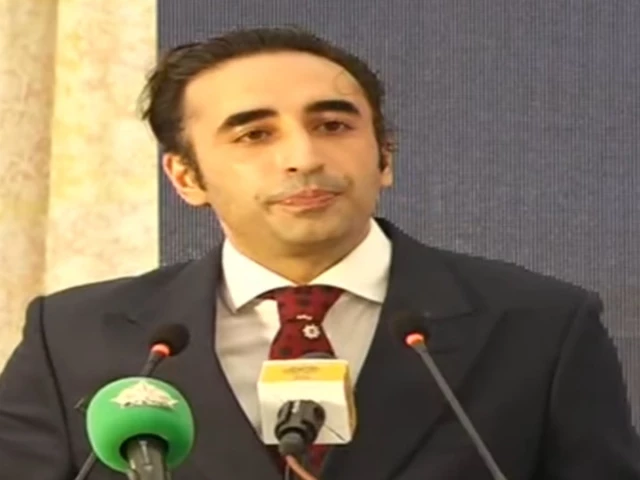
Bilawal Bhutto. Screengrab
MULTAN:
Pakistan Peoples Party (PPP) Chairman Bilawal Bhutto Zardari on Thursday said that he refused to become a “tissue paper” politician.
Using the metaphor to criticise puppet leadership and compromised political roles, Bilawal emphasized that he is unwilling to be used for others’ political purposes and would only pursue the premiership with genuine authority and independence.
Addressing a news conference at Multan Press Club, the PPP chairman called for a constitutional “reset” under the 1973 Constitution, electoral reforms, and the inclusion of all political stakeholdersincluding Pakistan Tehreek-e-Insaf (PTI) – to resolve political and economic challenges.
He said Pakistan Tehreek-e-Insaf (PTI) was a “political reality” and that its confidence in the political system must be restored for a broader democratic reset to take place.
“Whatever opinion you may hold about Khan sahib, even if you think he is not a political prisoner, there is no denying the fact that PTI is a political reality,” Bilawal told the media.
He said former prime minister Imran Khan was in jail following his conviction but argued that prisoners were entitled to their rights regardless of whether they were considered political prisoners, convicted felons or terrorists.
Bilawal said he did not want to perpetuate a cycle of political vengeance, despite alleging that Khan had denied his family similar rights in the past.
“Until PTI’s trust is restored in this system and they are able to play their role in parliament, the reset that is being discussed cannot take place in that manner,” he said.
Bilawal, who has been visiting Punjab, also backed resolutions passed by the Punjab and Sindh assemblies opposing the division of the provinces. He said the PPP maintained the same position in both provinces and that the Sindh Assembly had repeatedly rejected proposals to divide Sindh.
He warned that a referendum on provincial boundaries could trigger further controversy. If a referendum were held on the issue, voters should also be consulted on the 26th and 27th constitutional amendments and Khan’s political imprisonment, he said.
Bilawal said he opposed dividing Punjab and described the PPP as a pro-Pakistan rather than merely a pro-federation party.
Bilawal called for a new Charter of Democracy, saying political parties must work together to restore confidence in parliament and the electoral system.
He said both the government and opposition had objections to the current electoral process and warned that elections and referendums would remain controversial unless political parties trusted the system.
The government should consult opposition parties to rebuild confidence, he said, adding that distrust between the two sides was mutual. The PPP, PTI and another major opposition party had a history of mistrust, he said, but the opposition also had a responsibility to engage in confidence-building efforts.
All major decisions should be made in parliament, Bilawal said, warning that decisions taken outside the legislature weakened the system and its ability to address national challenges.
He criticised opposition parties for boycotting parliamentary committees, including those dealing with finance and judicial affairs, and urged them to contribute to budget discussions and other policy decisions.
Bilawal said politicians and the media were avoiding the country’s economic crisis, which was placing increasing pressure on ordinary households.
People were struggling to afford daily meals, healthcare and transport, he said, adding that some workers were spending their entire salaries commuting to and from work.
Young people were also struggling to find jobs despite obtaining university degrees, he said.
“These are the real issues,” Bilawal said, arguing that the political system needed to be capable of addressing the economic pressures facing the public.
He said the proposed system reset should be democratic and political, with the government, opposition and other relevant stakeholders involved in consultations.
Bilawal said a free press was essential to democracy and called for the media to play a stronger role in holding those in power accountable.
Pakistan’s independence movement had been fought through peaceful means and the power of the pen rather than arms, he said, adding that the media should be able to scrutinise governments without restrictions.
He said he had no intention of bringing down the government but wanted journalists to hold those in power accountable and help inform political decision-making.
Bilawal also said he was willing to acknowledge past mistakes and revisit legislation, including the Prevention of Electronic Crimes Act (PECA), which he said had previously received his support.
“Freedom of media is a major precursor for a democratic reset,” he said.
He added that the opposition should participate in parliamentary committees and take responsibility for decisions affecting the country rather than boycott the legislative process.