Washington — For months, Democrats have made ending the Iran war a core part of their pitch to midterm voters, promising that if they win control of Congress, they’ll push President Trump to end an unpopular conflict that they blame for price increases.
Now, with Democrats set to take decisive majorities in the House and Senate next year, some members want to use the power of the purse to pressure the Trump administration to wind down the war, using must-pass bills as leverage. Exactly when — and how — they plan to act are less clear.
Democratic Rep. Rosa DeLauro of Connecticut told CBS News before the election that she would support “cutting off the funds for the Iran war.” DeLauro is set to chair the powerful House Appropriations Committee, which has the ability to block funding.
“If they want money, they have to get congressional approval,” DeLauro said.
The first pressure point could arrive in a matter of weeks, before Democrats take control of Congress. Lawmakers face a Dec. 11 deadline to extend funding for most federal agencies and prevent a government shutdown. Several Democrats have argued the party should block any stopgap bill that doesn’t restrict funding for the Iran war.
But some top House Democrats who will control key committees next year are backing away from that approach, warning it could lead to a shutdown.
DeLauro is part of government funding negotiations and favors a short-term extension until February if full-year appropriations measures are not passed by the deadline. She indicated that she is against using a continuing resolution as leverage.
“I think that the American people would like to see us end the war,” she told reporters Wednesday. “I also believe that the American people may not believe that shutting the government down ends the war.”
In a statement to CBS News on Thursday, Rep. Gregory Meeks of New York said he would oppose a continuing resolution “if I believed shutting down government helped us actually achieve that.”
“But I believe it would only shut down parts of government that Americans rely on,” said Meeks, who is the incoming chair of the House Foreign Affairs Committee.
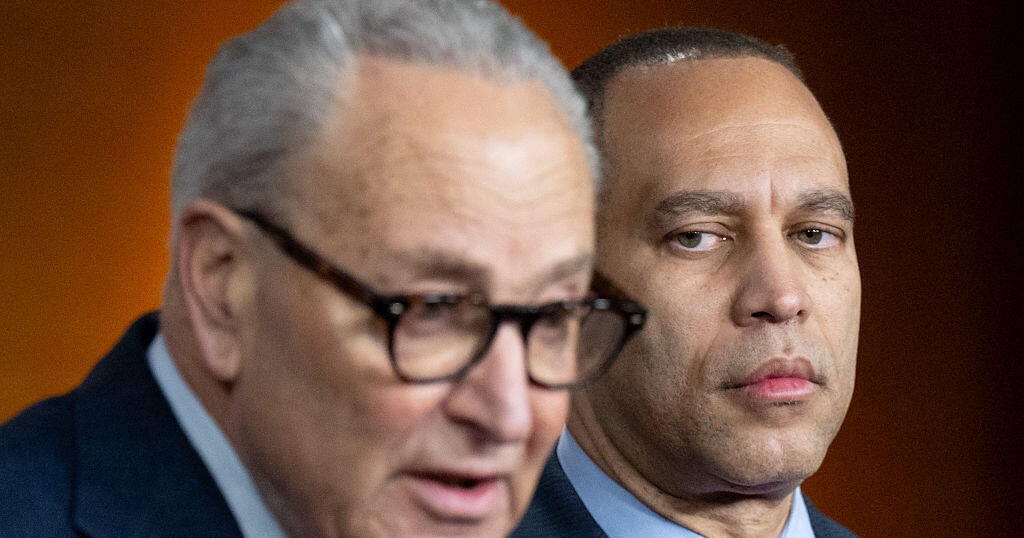
The party’s House and Senate leaders — Rep. Hakeem Jeffries and Sen. Chuck Schumer — support ending the Iran war but have not specified what their approach will be, including whether they’re open to attaching language to a stopgap funding bill.
Jeffries said Tuesday the House and Senate appropriations committees are in “active conversation” about how to fund the government.
“I don’t want to get out ahead of that process,” he told reporters at a news conference. “What is clear is that the reckless and costly war of choice in Iran needs to end. It should end today.”
Democratic Sen. Chris Van Hollen of Maryland, who is challenging Schumer for majority leader, has argued the party should use the Dec. 11 deadline to force restrictions on the Iran war.
Van Hollen said in a statement last week that any funding deal “must include language that restricts the Trump Administration from using appropriated funds to continue his war against Iran.” It was cosigned by Sen. Tammy Duckworth of Illinois, progressive Sen. Bernie Sanders of Vermont and more moderate Sen. Michael Bennet of Colorado.
Some Democrats also plan to offer amendments to any government funding deal to block war funding until the conflict is authorized by Congress, including Bennet, Duckworth, Sen. Elizabeth Warren of Massachusetts and Schumer-allied Sen. Kirsten Gillibrand of New York.
Senate Democrats discussed how to proceed during a closed-door lunch meeting on Tuesday. Van Hollen told reporters they “had a very good discussion,” but there was “no final decision.”
Reps. Yassamin Ansari of Arizona and Ro Khanna of California said they would also vote against any funding package that “does not explicitly prohibit funds from being used for offensive operations in Iran.”
What could Democrats do next year?
After Democrats formally take control of the House and Senate in January, they could have several opportunities to attach Iran war-related language to must-pass legislation, in addition to voting on standalone bills and resolutions to restrict the war.
Lawmakers will likely need to extend government funding again, and they will need to raise the debt limit at some point next year. The appropriations process for the 2028 fiscal year and the annual National Defense Authorization Act are two other possible points of leverage.
Schumer told reporters earlier this month that “we are going to end the war,” and said, “the Founding Fathers had the power of the purse as one of the ways of deterring a president who does war without the consent of the American people.”
Still, blocking the president from taking military action in Iran could be a challenging task.
“It is a complicated thing to force the president to stop using military force, and does require an alignment of political opportunity, savvy legislating, coordination that just is going to take time and political capital to implement,” said Scott R. Anderson, a former State Department attorney and Brookings Institution senior fellow.
Mr. Trump has vowed to use his veto power liberally. Democrats would need support from several Senate Republicans and dozens of House Republicans to override his veto.
Beyond that, Mr. Trump and other presidents have claimed sweeping authority to direct the military. The president did not seek congressional authorization for the Iran war. Instead, he told lawmakers shortly after the war began that he “acted pursuant to my constitutional authority as Commander in Chief,” in a notice issued under the War Powers Resolution, which requires the president to notify Congress of military hostilities within 48 hours.
That 1973 law also limits hostilities to 60 days — with an extra 30-day grace period to withdraw troops — unless lawmakers pass an authorization for use of military force, and it allows Congress to pass resolutions directing the president to terminate hostilities before then.
House and Senate Democrats have used that law to vote to terminate hostilities several times this year, drawing support from some moderate or anti-interventionist Republicans. One war powers resolution cleared both chambers in June. But the Trump administration has brushed off those votes, arguing the War Powers Resolution is unconstitutional. On Thursday, the Senate blocked another House-passed resolution, losing Republican support for reining in Mr. Trump on Iran.
Jeffries said Tuesday that House Democrats are discussing whether to force more votes on war powers resolutions this year.
“It’s something that’s under discussion right now, and we’ll take a look at vehicles that we have available to us,” he said. “But it certainly is the case that early on in the new Congress, we’re going to aggressively move to end the reckless Republican war of choice in Iran.”
Later in the day, during an interview at the Atlantic Summit in Washington, Jeffries indicated that Democrats would vote next year on a resolution “that has the force of the law.”
The resolution that cleared the House and Senate in June was passed under a procedure that did not require the president’s signature.
Jeffries said the goal is to send a war powers resolution to Mr. Trump’s desk, essentially daring him to veto it. The war remains deeply unpopular with Americans.
“There’s nothing more powerful than putting that bill on the president’s desk,” Jeffries said.
Meeks told CBS News that starting in January, “I will introduce a War Powers Resolution, support legislation that cuts off funding for this war, and require the administration to take diplomacy seriously by sending real diplomats, not the president’s golf buddy and son in law.”
Other Democrats have backed using funding bills as leverage. Sen. Tim Kaine of Virginia said in one recent interview that if the Trump administration doesn’t follow already-passed war powers resolutions, “our only choice is to use the appropriations process to forbid funding for war operations, unless the president gets the legally required authorization by Congress.”
Asked about Democrats’ plans, a White House official told CBS News: “As President Trump and Secretary Rubio stated, our economic pressure campaign is devastating Iran to such an extent that the President does not have any need to conduct major combat operations.”
“The Democrats continue to prove that have no agenda to improve the lives of the American people, just plans to baselessly obstruct the President’s agenda,” the official said.
What could restrictions on the Iran war look like?
There is some history of Congress constraining the president’s ability to make war. In 1973, the House and Senate overwhelmingly passed legislation blocking the government from using funds for hostilities in Vietnam, Cambodia and Laos. Then-President Richard Nixon signed it into law.
Anderson told CBS News that if lawmakers want to force an end to the Iran war, they could pass legislation that either prohibits hostilities with Iran outright or bars the president from using federal funds to pay for the war, or both.
“You need some sort of affirmative bar to block the president from acting,” he said. “Even then, there’s kind of a question of, ‘Does the president listen? How enforceable is it?'”
Another open question: What specific military actions Democrats might try to ban.
The U.S. has not conducted large-scale offensive operations against Iran in recent months, but the conflict has remained at a simmer. The two countries have exchanged occasional strikes — typically after the U.S. military alleges imminent threats from Iran — and the U.S. has enforced a blockade on Iranian ports and escorted oil through the Strait of Hormuz.
Anderson says Congress could try to bar the Trump administration from resuming offensive bombings, and the blockade on Iran could also be restricted. Defensive operations are likely to be exempted, though the bill would need to be worded carefully.
In the past, Anderson notes, presidents have argued the Constitution inherently gives them the power to carry out operations to defend U.S. nationals, regardless of any legislative complications — an argument President Gerald Ford used to evacuate Saigon and order some other operations around the tail end of the Vietnam War.
“If you do an absolute funding cutoff, what do you do when you have U.S. vessels traversing the Strait of Hormuz and they do get shot at by Iranians, or American sailors get captured?” he said.
Democrats have yet to publicly lay out a plan for how they plan to counter the administration if it defies Congress on ending the war. If Democrats believe the administration isn’t complying with its obligations, the House or Senate could sue, but the outcome could be hard to predict.
Rep. Adam Smith of Washington, the incoming chairman of the House Armed Services Committee, has argued that impeaching Mr. Trump over the war should be an option.
“How are we going to stop him? What law are we going to pass when he chooses not to obey the law?” Smith said in an interview with CNN last month, prior to the election.
Smith told The New Republic earlier this month that even if Democrats forbid any funding for the war, “the legal language and the loopholes — the ways that Trump can sort of jump out of it — those will all continue to be challenges.”
“We are headed into uncharted territory here,” Smith said.
Anderson said he believes Democrats are serious about passing restrictions on the Iran war, but it could take multiple attempts and plenty of “political fighting and legal maneuvering.”
“People do need to be patient,” Anderson said. “There is this expectation that Democrats won and the Iran war will end tomorrow. That is not what is going to happen.”