Pakistan, Turkiye pledge support for Saudi Arabia
Condemn ‘heinous’ Houthi attacks on kingdom
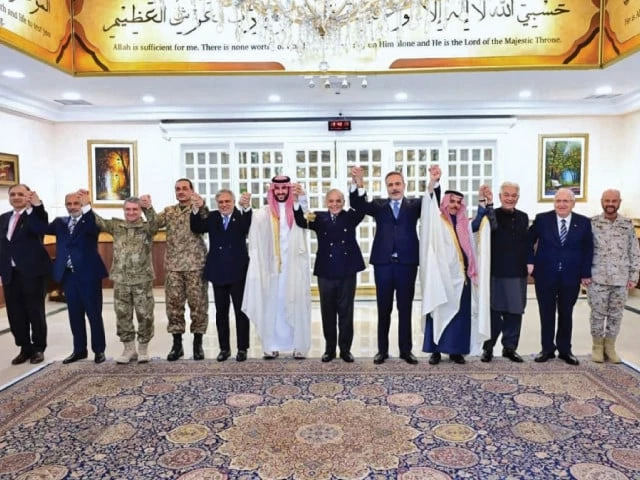
PM Shehbaz Sharif joins senior Saudi and Turkish officials in a show of unity and solidarity on the sidelines of the second meeting of the Strategic Political and Defence Committee (S-PDC) in Islamabad. Photo: APP
ISLAMABAD:
Pakistan, Saudi Arabia and Türkiye on Friday reaffirmed their collective defence commitment under the Makkah pact, strongly condemning continued Houthi attacks on the kingdom as Islamabad and Ankara pledged to accelerate efforts to support Saudi security, sovereignty and its territorial integrity.
The commitment was made at the second meeting of the high-powered Strategic Political and Defence Committee (SPDC) of the Makkah Alliance for Defence in Islamabad, where the three countries expressed solidarity with Saudi Arabia over attacks targeting civilians and civilian infrastructure.
In a joint statement, the three sides described the attacks by the Houthi militia as persistent and heinous, reaffirming their collective resolve to step up efforts to support the Kingdom in safeguarding its security in accordance with the collective defence provisions of the Makkah Joint Defence Agreement.
The explicit reference to the Houthi threat highlights the security dimension of the alliance, which brings together three influential regional powers at a time of heightened instability across the Middle East.
The meeting was attended by senior political and military leadership from all three countries, underlining the importance they attach to translating their defence commitments into a functioning institutional framework.
Deputy Prime Minister and Foreign Minister Ishaq Dar, Defence Minister Khawaja Muhammad Asif and Chief of Defence Forces and Chief of Army Staff Field Marshal Syed Asim Munir represented Pakistan.
The Saudi delegation was led by Defence Minister Prince Khalid bin Salman bin Abdulaziz Al Saud and included Foreign Minister Prince Faisal bin Farhan Al-Saud and Chief of the General Staff General Fayyadh bin Hamed Al-Ruwaili.
Türkiye was represented by Foreign Minister Hakan Fidan, National Defence Minister Yasar Güler and Chief of the General Staff General Selçuk Bayraktaroglu.
The committee reviewed the evolving regional security situation and reaffirmed its commitment to collective defence, mutual solidarity and respect for the sovereignty and territorial integrity of all three countries.
It also reviewed progress on implementing decisions taken at the alliance’s inaugural meeting in Istanbul on August 31 and an emergency meeting in Riyadh on October 5, particularly those concerning its institutional structure and the practical implementation of collective defence commitments.
Significantly, the three countries expressed satisfaction over the pace of progress towards establishing and operationalising the alliance’s secretariat in Saudi Arabia. The joint statement praised the progress made so far, describing the secretariat as an important component in supporting the alliance’s institutional work and ensuring effective coordination among its members.
The three sides also agreed to strengthen cooperation in defence industries, joint technological development, military training and capacity-building to enhance the collective capabilities and cohesion of their armed forces.
Alongside defence cooperation, the committee emphasised political coordination, agreeing to continue consultations on regional developments, support efforts to de-escalate tensions and promote peaceful resolution of disputes through dialogue and diplomacy.
The meeting did not announce any new military deployment or joint operational command, with the focus remaining on institutionalising the alliance and advancing practical arrangements for implementing its collective defence commitments.
Pakistan, Saudi Arabia and Türkiye signed the Makkah Joint Defence Agreement on August 7, during a meeting involving Prime Minister Shehbaz Sharif, Saudi Crown Prince Mohammed bin Salman and Turkish President Recep Tayyip Erdogan.
The agreement established a framework for closer military cooperation, centred on the principle that an armed attack against one member would be considered an attack against all.
Since its signing, the three countries have held a series of political and military consultations to work out the institutional arrangements required to implement the agreement.
For Pakistan, the alliance provides an additional framework to deepen its longstanding strategic relationship with Saudi Arabia while expanding defence and technological cooperation with Türkiye.
The Islamabad meeting marked another step towards giving the agreement a more concrete institutional shape. Its eventual effectiveness, however, will depend on how the three partners translate their collective defence pledge into practical arrangements and coordinated responses to emerging security challenges.
The joint statement said the meeting reflected the longstanding friendship and solidarity among the three countries and their shared commitment to regional and international peace, security and stability.
The Second S-PDC meeting builds on decisions taken in Istanbul and Riyadh, translating the Alliance agreement into a more coordinated security framework.
Pakistan, Saudi Arabia and Türkiye reiterated their commitment to mutual solidarity and to safeguarding each other’s sovereignty and territorial integrity.
Progress towards establishing the Alliance Secretariat in Saudi Arabia will create a dedicated mechanism for sustained coordination and implementation.
Hosting the high-level meeting brought together the three countries’ foreign ministers, defence ministers and military chiefs to advance a shared security agenda.
The three countries condemned Houthi attacks targeting Saudi civilians and infrastructure and reaffirmed their collective support for the Kingdom.
Joint defence production, technology development, training and capacity-building will strengthen capabilities and interoperability among the three armed forces.
The partners committed to continued consultations, regional de-escalation and the peaceful resolution of disputes through dialogue.
Regular consultations, institutional mechanisms and practical defence cooperation will provide a sustained framework for addressing shared security challenges and promoting regional stability.