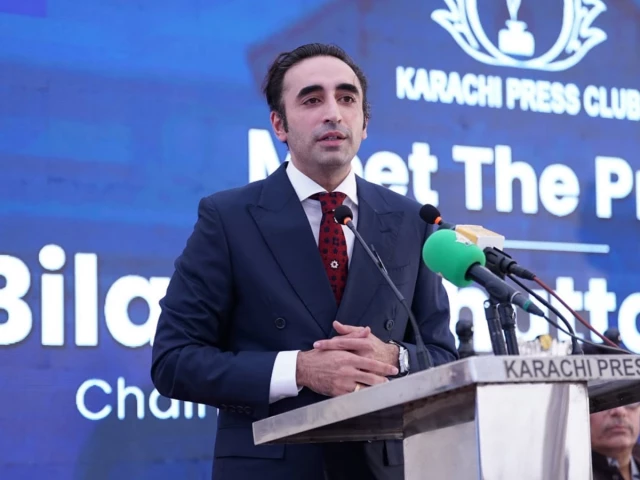
PPP chairman Bilawal Bhutto addressing media persons at the Karachi Press Club on November 17, 2026. Photo: PPP on X
ISLAMABAD:
Several federal ministers hit back at Pakistan Peoples Party (PPP) Chairman Bilawal Bhutto Zardari on Wednesday following his strong criticism of the government and demand for a “political reset”, questioning his “moral standing to lecture others” while benefiting from the same system.
Defence Minister Khawaja Asif, Parliamentary Affairs Minister Tariq Fazal Chaudhry, Health Minister Mustafa Kamal and Minister of State Talal Chaudhry criticised the PPP chief for opposing the proposal of a referendum on the new provinces issue, asking why he was afraid of taking the issue to the people’s court.
Bilawal delivered a hard-hitting speech at the Karachi Press Club on Tuesday, calling for a “political reset” and criticising the government over its handling of governance and constitutional matters. He also vehemently rejected the proposal to hold a referendum on the creation of new provinces.
“If you are talking about a system collapse, then, as we are all connected to this system, it is also necessary for us to take stock of our responsibilities,” Khawaja Asif wrote on X. “He who claims equity must come with clean hands Are your own hands clean? Do you have the right to lecture others or issue threats?” he said.
Asif challenged Bilawal’s criticism of the existing political system by drawing attention to the PPP’s governance record in Sindh, where the party has been in power for 18 years. In a sarcastic tone, he said that under PPP rule, “Sindh has become a paradise” and that the world envied Karachi’s condition.
Asif also referred to the PPP’s alliance with the Pakistan Muslim League-Nawaz (PML-N) at the Centre since 2022, questioning whether the party was willing to share responsibility for the government’s shortcomings. “The profit is yours, while the loss belongs to the PML-N or Pakistan!”
The defence minister emphasised that no system could be reset without public support and stressed that the people’s right to have a say in the country’s affairs could not be denied. He said the issue of a “system reset” would certainly be debated in parliament, but this should not deprive the public of their fundamental right to express its opinion.
“Our foundation as politicians is public opinion. There is no restriction on parliamentary debate and discussion alongside a public referendum. If the opinion of the people is also sought alongside parliament, then, in my view, that would be the pinnacle of legitimacy,” Asif added.
He advised the PPP chairman to “make public participation in governance a reality”, stressing: “The power of rulers is a trust belonging to the people, not anyone’s inheritance. Do not confine the rights of the people to the pages of the Constitution.”
His views were echoed by Talal Chaudhry at a press conference in Islamabad. He questioned why the PPP chairman feared a public vote if he believed political decisions should be made through “the ballot rather than the bullet”.
Chaudhry particularly took aim at Bilawal’s warning that blood would flow in the streets of Sindh if the province was divided by force. “The question is: does casting a vote lead to bloodshed, or does it prevent bloodshed?” he told reporters.
Chaudhry also challenged Bilawal’s claim that votes on the 27th Constitutional Amendment had been cast under pressure. He referred to the PPP chairman’s speech in the National Assembly in support of the amendment, recalling his remarks that “a constitutional court was Quaid-i-Azam’s dream”.
He accused Bilawal of accepting only parts of the Constitution, while seeking to retain control over provincial resources and the benefits they “generated for the PPP” rather than the people living in those provinces. He said constitutional provisions had to be implemented in practice to allow people to “heave a sigh of relief”.
In a post on social media platform X, Tariq Fazal Chaudhry also questioned why the PPP, “which claims to uphold democracy and the supremacy of the Constitution”, was reluctant to seek public opinion on the creation of new provinces.
He said a referendum was not an unconstitutional demand but a democratic option provided for in the Constitution. “Let the people speak, respect their opinion and accept whatever decision they make. That is the democratic approach and the demand of public politics,” he said.
Health Minister Mustafa Kamal, while addressing a press conference at the National Press Club in Islamabad, warned that Bilawal Bhutto Zardari would be held responsible for any bloodshed over the creation of new provinces, stressing that smaller provinces were essential for Pakistan’s future.
“If even a single drop of blood is shed, Bilawal Bhutto will be responsible,” Kamal said. He questioned why the PPP opposed the creation of new provinces if it believed it had delivered good governance in Sindh. He said there should be no objection even if Sindh were divided into 10 provinces with 10 chief ministers.
Information Minister Attaullah Tarar had also defended the referendum proposal, saying it was a constitutional and legal way to ascertain public opinion on the creation of new provinces. He also reminded Bilawal that the PPP was part of the same government.
Political parties that had been in power for decades could not distance themselves from the weaknesses of the existing system, Tarar said, criticising what he described as a contradiction in enjoying government positions and privileges while presenting themselves as opposition.