Ministry of energy says will establish Joint Commercial Team to develop a roadmap to accelerate project
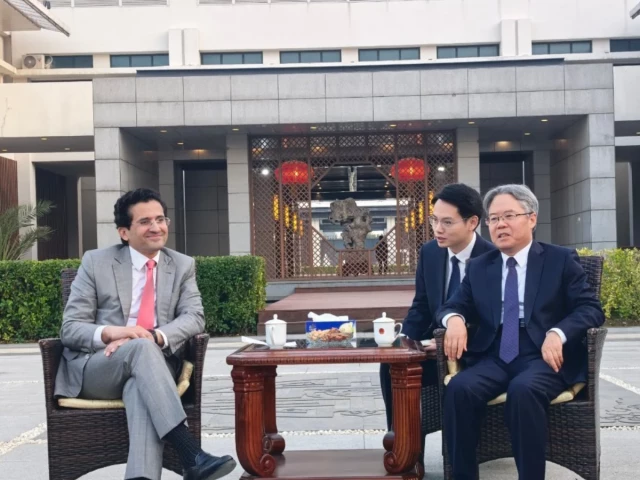
Minister for Petroleum Ali Pervaiz Malik (left) meets Chinese Ambassador Jiang Zaidong in Islamabad on Wednesday. PHOTO: X
Energy Minister Ali Pervaiz Malik and Chinese Ambassador Jiang Zaidong on Wednesday agreed to fast-track liquefied petroleum gas (LPG) plant and petrol import projects, the Ministry of Energy said.
In a post on X, the ministry said the two sides, in a meeting, also agreed to establish a Joint Commercial Team, which will develop a roadmap to accelerate project implementation and investment.
Malik said our priority is to transform dialogue into practical projects and industrial development.
“Both sides agreed to fast-track LPG plant and petrol import projects and establish a Joint Commercial Team to turn investment opportunities into concrete projects,” the ministry said.
Federal Minister Ali Pervaiz Malik met 🇨🇳 Amb H.E Jiang Zaidong to advance investment in Pak’s energy sector.Both sides agreed to fast-track LPG plant & petrol import projects and establish a Joint Commercial Team to turn investment opportunities into concrete projects (1/2) pic.twitter.com/2ITiJWTjRX
— Petroleum Division, Ministry of Energy (@Official_PetDiv) November 25, 2026
The meeting was aimed at advancing Chinese investment in Pakistan’s energy sector, it added.
The latest discussions with the Chinese ambassador also covered potential cooperation in upstream oil and gas exploration, offshore development and mineral resources.
According to a statement issued by the Petroleum Division on Tuesday, Pakistan State Oil (PSO) would serve as a potential commercial partner for Chinese companies exploring investment in downstream infrastructure, while the proposed Joint Commercial Team would assess investment opportunities, engage prospective companies and develop a roadmap for implementation.
The latest engagement came amid renewed efforts by Pakistan to attract Chinese investment in its petroleum and energy infrastructure, including oil and gas exploration, refinery modernisation, storage facilities and offshore development.
Read: LNG imports to cost over $1b in winter
In July, Malik met a delegation led by Hou Jianxin, chairman of China’s Shandong Xinxu Group, which expressed interest in a long-term partnership covering oil and gas production, refinery upgrades, offshore exploration and energy equipment manufacturing.
The proposals also included establishing an equipment manufacturing facility in Pakistan to serve domestic and export markets.
In September, Malik also held separate meetings with representatives of energy infrastructure company VTTI and technology firm Honeywell UOP to explore investment in petroleum storage, LPG terminals and refinery modernisation.
VTTI expressed interest in developing bonded warehousing and re-export facilities, as well as expanding LPG storage infrastructure, while Honeywell UOP discussed opportunities to introduce advanced refining technologies in Pakistan.
Pakistan has been grappling with uncertainty over imported gas supplies amid disruptions to liquefied natural gas (LNG) shipments from Qatar following the conflict in the Middle East and instability around the Strait of Hormuz.
Read more: Pakistan, Oman seal $200m energy deal
With domestic gas production insufficient to meet winter demand, the government has turned to the international spot market to secure additional cargoes, at considerably higher prices than those under its long-term agreements with Qatar.
Pakistan planned to import 10 spot LNG cargoes between November 2026 and February 2027, alongside 12 shipments under its existing agreements, with the overall winter import bill projected to exceed $1.2 billion. The supply constraints have also prompted the government to consider allowing power producers to use idle capacity at LNG terminals to arrange their own imports.