CM says Pakistan emits less than 1% of global CO2 yet faces devastating climate disasters
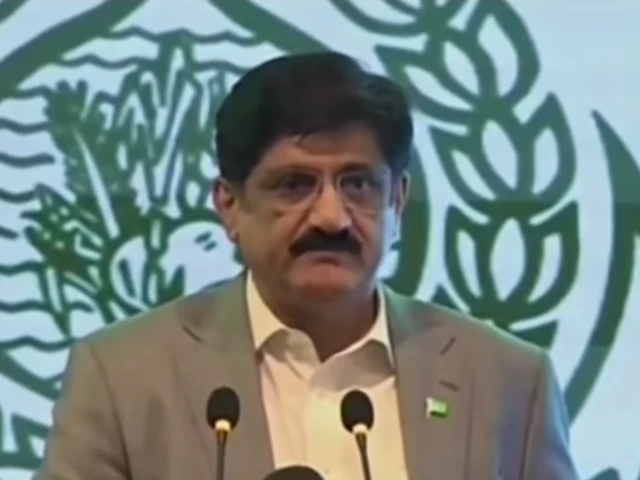
Sindh Chief Minister Murad Ali Shah speaking at a ceremony marking the first anniversary of Marka-e-Haq in Karachi. SCREENGRAB
KARACHI:
Sindh Chief Minister Murad Ali Shah has called for climate justice and equitable climate financing for developing countries, telling a United Nations climate conference that Pakistan contributes less than 1% of global carbon dioxide emissions but continues to suffer the devastating consequences of global warming.
Addressing the 31st United Nations Climate Change Conference (COP31) in Antalya, Turkiye, CM Shah urged the international community to strengthen cooperation, ensure fair distribution of climate finance and facilitate technology transfer to vulnerable countries. He said developing nations, despite contributing the least to global emissions, were bearing the heaviest burden of climate change.
Citing Pakistan’s experience, the chief minister said the country faced catastrophic floods, extreme heat, droughts and coastal threats. The 2022 floods affected 33 million people nationwide, claimed more than 1,700 lives and caused economic losses exceeding $30 billion. Sindh alone suffered nearly 70% of the overall damage, he added.
Shah said his government had adopted a strategy of rebuilding safer and more resilient communities rather than merely repairing infrastructure damaged by the floods.
Highlighting the Sindh People’s Housing Programme, he said the provincial government had launched the world’s largest post-disaster housing reconstruction initiative, targeting 2.1 million climate-resilient homes for affected families.
More than one million houses had been completed in three-and-a-half years, while another 700,000 were at various stages of construction, he said. More than 42,000 community committees had been established and over 1.7 million bank accounts opened to facilitate direct financial assistance to beneficiaries.
Women had been given a central role through property ownership and financial empowerment, enabling families to rebuild their homes with direct government support, he added. Shah recalled that World Bank President Ajay Banga had appreciated the programme’s scale, direct banking mechanism and community participation during his visit to Larkana.
On flood protection, the chief minister said Sindh had reconstructed 205 kilometres of protective embankments, restored 157,000 hectares of agricultural land and strengthened Manchar Lake’s protective system, increasing its water discharge capacity to 83,500 cusecs.
He said all 44 gates of Sukkur Barrage had been replaced, while 54 of the 65 gates at Guddu Barrage had been reconstructed. The provincial government aimed to complete the rehabilitation and modernisation of barrages by 2027.
The government was also rebuilding 5,811 flood-damaged schools, rehabilitating 141 roads spanning 825 kilometres across 19 districts and restoring more than 1,000 damaged health facilities, with particular attention to maternal and child healthcare.
Turning to environmental protection, Shah said Sindh had restored 126,000 hectares of mangrove forests in the Indus Delta, with a target of expanding the area to 225,000 hectares by 2030. The Delta Blue Carbon initiative was expected to reduce or absorb 142 million tonnes of carbon dioxide, while 5.6 million tonnes of carbon credits had been verified.
He stressed that mangroves were essential for protecting coastal communities from erosion and cyclones, preserving marine biodiversity and supporting livelihoods. Maintaining freshwater flows from the Indus was equally important to sustaining the delta’s ecological balance, he added.