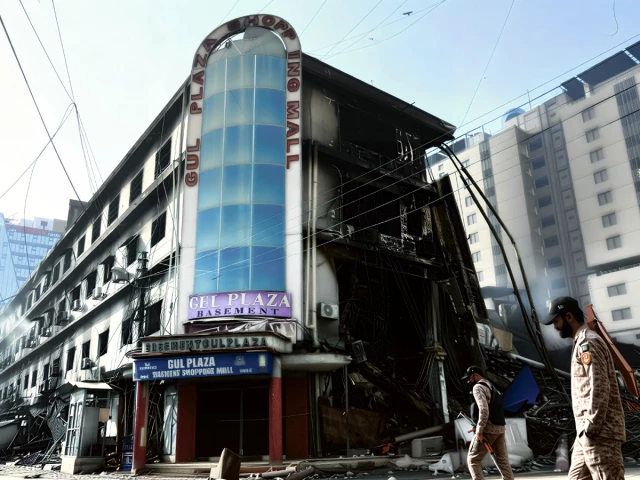
Paramilitary personnel walk past charred remains of the Gul Plaza shopping mall in Karachi on Jan 22, 2026. PHOTO:AFP
The devastating fire at Karachi’s Gul Plaza, which claimed 79 lives and left dozens missing, was triggered by a matchstick at an artificial flower shop, according to the Sindh government’s investigation report. The report also exposed severe lapses by the mall administration and rescue services that led the blaze to escalate. The tragedy was not the result of a single mistake, but of years of neglect, regulatory failures, and dangerous compromises.
The investigating team recorded statements from 19 witnesses, including the president of the Gul Plaza shops union, shopkeepers, workers, and security guards.
Fire at Gul Plaza: A timeline of disaster
The fire began at around 10:15 pm in a ground-floor shop selling artificial flowers. Within minutes, flames and thick smoke engulfed the building, turning one of Karachi’s busiest commercial centers into a deadly inferno. The blaze ultimately claimed 79 lives, injured dozens, and revealed deep-rooted failures in urban safety governance.
Where it all began: A flower shop and a matchstick
According to the inquiry report, the fire originated at Shop No. 193, “New Tawakal Flower & Gift Shop”, located near Gate No. 6 on the ground floor. The shop’s owner, Naimatullah, had left the premises earlier in the evening, leaving his 11-year-old son Huzaifa behind.
Another boy, 13-year-old Aryan, joined him. During their interaction, Huzaifa lit a matchstick. The matchstick accidentally fell onto artificial flowers, igniting a fire. Due to the highly combustible nature of the materials, the fire rapidly intensified within the shop and quickly spread to the adjoining establishments. Talha, a worker at a neighboring shop, witnessed the incident in its entirety, revealed the report.
Panic, darkness, and suffocation
As the fire spread, electricity was switched off around 10:20 pm as a precautionary measure. While intended to prevent short circuits, the blackout plunged the plaza into darkness, triggering panic among the estimated 2,000 to 2,500 people inside. Smoke quickly filled corridors and stairwells, reducing visibility to near zero. Many fire exits were locked, blocked, or encroached upon, and narrow staircases slowed evacuation.
The mezzanine floor proved deadliest, as smoke from the ground floor rose rapidly, trapping dozens inside shops with iron grills and limited escape routes. Several victims died of suffocation while desperately trying to break out.
Emergency response: Fast calls, slow relief
The first emergency call to the KMC Fire Helpline (16) was made at 10:26 pm, and police, Rescue 1122, and municipal authorities arrived soon after. However, responders faced critical obstacles. Water shortages delayed the arrival of the first water bowser by nearly 90 minutes. Lack of equipment, including metal cutters to break grills, limited access points due to sealed windows and encroachments, and structural instability forced firefighters into a defensive strategy.
By 10:50–10:55 pm, the fire had escalated into a third-degree blaze, engulfing the entire structure and rendering early firefighting efforts largely ineffective. The fire took over 48 hours to fully extinguish, during which three sections of the building collapsed.
A building unfit for emergencies
The investigation revealed that Gul Plaza had been a fire hazard long before the incident. Despite multiple fire safety audits by Civil Defence and KMC, the building lacked fire alarm systems, sprinklers, hydrants, emergency evacuation plans, proper aisle markings, and functional emergency exits. Although fire extinguishers were present, they were no match for a blaze fueled by wooden lofts, unsafe wiring, plastic goods, and air-conditioning ducts that acted as fire conduits.
The building had deviated significantly from its approved plan: the number of shops increased from 1,102 to 1,153, staircases were narrowed, and exit gates were reduced — all without safety considerations.
CCTV evidence and eyewitness accounts
CCTV footage showed smoke emerging as early as 10:22 pm, with visible flames by 10:36 pm. Multiple eyewitnesses confirmed that the fire spread rapidly due to combustible materials and poor layout. Several survivors described being trapped behind iron grills, struggling to breathe, and escaping only by breaking doors or being pulled out by others. Some rescuers and shopkeepers lost their lives while trying to save others.
Who was responsible?
The inquiry concluded that gross negligence was central to the tragedy. Irresponsible conduct by the shop owner, failure of plaza management to ensure fire safety compliance, regulatory lapses by building control and enforcement authorities, lack of follow-up on repeated fire safety warnings, and inadequate preparedness of firefighting agencies all contributed to the disaster. Poor coordination, delayed water supply, weak crowd control, and insufficient training of emergency responders compounded the calamity.
Recommendations
To prevent future tragedies, the committee recommended immediate fire safety audits of all high-risk buildings, mandatory post-construction inspections by SBCA, installation of modern fire suppression systems, upgradation and better training of firefighting agencies, merging fire and rescue services under a single command, and active involvement of trade bodies and builders in enforcing a safety culture.
The Gul Plaza fire was not just an accident; it was a systemic failure decades in the making. The inquiry report serves as a stark reminder that without strict enforcement, transparency, and accountability, Karachi’s crowded commercial buildings remain ticking time bombs.