
PUBLISHED
November 29, 2026
Before a single word of romance is spoken, the Bennet household and the wider parish of Meryton are already buzzing with speculation, marital math, and character assessments. In the world of Jane Austen, gossip is not mere background noise; it is the pulse keeping a tightly knit society alive. Whispers traded at assembly balls and over morning tea shape the judgement of Austen’s heroines. They learn through society who is trustworthy, who is a fortune-hunter, and who harbours hidden depths. Yet, Austen is equally clear-eyed about the peril of the tongue. A careless word from Lady Catherine de Bourgh or a malicious fabrication from George Wickham ruins reputations, fractures families, and nearly derails lives.
Centuries away from regency drawing rooms, my relationship with gossip remains just as conflicted. We condemn it in polite company, label it petty or toxic, and routinely claim to rise above it. Yet the moment two friends sit down across a café table, the conversation almost invariably drifts toward the people they mutually know. For me, I gossip with people I am close to, not with acquaintances. It still comes with guilt in hindsight for having dissected someone’s life in their absence, and with virtuous disclaimers of how we don’t mean them any ill.
At the after party of a family wedding, for example, when all the cousins were bursting with what they overheard or saw, I declared it useless to feel bad about trading notes. We are just sharing facts, I proclaimed. When you know you want to gossip and you are deriving entertainment from it, why do we treat it as a moral failing? More provocatively, if we stripped all talk of other people from our social lives, would there be anything left worth saying?
The glue of human connection
Guess what: the practice of gossip is not even trivial. Oxford anthropologist Robin Dunbar argues in his landmark work Grooming, Gossip, and the Evolution of Language, that human language did not evolve primarily to coordinate hunts or debate philosophy. It evolved so we could gossip.
Among non-human primates, social cohesion is maintained through physical grooming, which releases endorphins and forges alliances. But physical grooming is a one-on-one activity with strict time limits. As early human social groups grew to around 150 individuals, our ancestors simply ran out of hours in the day to pick bugs out of every ally’s fur. Language solved this bottleneck by introducing “vocal grooming”. Through conversation, early humans could bond with multiple allies simultaneously while keeping their hands free.
Dunbar’s research into modern human conversation reveals that roughly two-thirds of our daily speaking time is devoted to social topics, who is doing what with whom, who is in trouble, and who can be trusted. When we meet face-to-face and trade updates about mutual acquaintances, we are not indulging in a modern vice; we are performing an ancient maintenance ritual for our social networks.
Sharing a piece of social information signals trust. Saying, “Did you hear what happened to Sarah?” is an implicit offer of intimacy, an invitation into an inner circle of shared context.
Gossip vs backbiting
Part of the reason gossip suffers from such a poor reputation is that we lump every form of third-party conversation into the same bucket. Psychologists and sociologists draw sharp distinctions between benign social talk, protective warning systems, and outright malice.
When a colleague quietly warns a new hire not to rely on a chronically late teammate before a major deadline, or when neighbours share news of a local contractor who overcharges, they are engaging in prosocial gossip. This is the everyday exchange of reputational information that helps groups function smoothly. Studies show this form of talk actively deters selfishness and “free-riding” because people know their behaviour will be discussed.
Sharing updates or information such as catching up on a mutual friend’s promotion, divorce, or move to a new city falls under basic social bookkeeping. It keeps the community map updated without passing moral judgment.
Here is where toxicity enters the room: backbiting. Backbiting is defined by its intent to harm, humiliate, or manipulate. Unlike ordinary gossip, which is often rooted in genuine curiosity or concern, backbiting thrives on cruelty, exaggeration, or fabrication. It occurs when a speaker shares private confidences to elevate their own status at someone else’s expense.
The difference lies less in the act of talking about an absent person and more in the underlying currency of the conversation. Healthy gossip trades in empathy, context, and social calibration; toxic backbiting trades in schadenfreude and character assassination.
The stoic and the chatterbox
Of course, not every philosophical tradition is willing to grant gossip an evolutionary pass. If you were to invite the Roman Emperor Marcus Aurelius to your next coffee date, he would likely urge you to keep your eyes strictly on your own plate.
Writing in Meditations, Aurelius repeatedly warned himself against the distraction of other people’s lives. “How much time he gains who does not look to see what his neighbour says or does or thinks, but only at what he does himself, to make it just and holy,” he wrote. For the Stoics, mental energy is a finite, sacred resource. Every minute spent dissecting someone’s flaws or speculating about a rival’s motives is a minute stolen from cultivating one’s own virtue, wisdom, and self-control.
Aurelius also recognised the subtle arrogance embedded in most gossip.
When we dissect someone else’s poor choices, we implicitly place ourselves on a moral pedestal, judging their motivations while forgiving our own. I think this is where the guilt of gossiping stems from. Yet even the Stoics had to live in the real world. Aurelius acknowledged that every morning he would encounter people who were “meddling, ungrateful, arrogant, dishonest, jealous, and surly”. His solution was not to isolate himself from society, nor to pretend human flaws didn’t exist, but to observe them with detached compassion rather than spiteful delight.
Aren’t non-gossips… boring?
This brings us to a delicate social truth that Stoic philosophy rarely addresses: the art of conversation. Eleanor Roosevelt famously suggested that “Great minds discuss ideas; average minds discuss events; small minds discuss people.” Having heard this from a young age, this lovely aphorism prickles my conscience when we pop open a bottle of bubbly gossip.
But imagine sitting across from someone at a dinner party who steadfastly refuses to discuss a single mutual friend, family member, or public figure. Every attempt to ask, “How is your brother handling the new job?” or “Did you see what happened at the office yesterday?” is met with a polite deflection toward abstract concepts like macroeconomic policy, climate science, or the AI takeover. Within twenty minutes, the interaction begins to feel less like a friendship and more like an academic seminar.
People who claim they “never gossip” often confuse moral superiority with emotional detachment. Humans make sense of abstract ideas through concrete human stories. We do not discuss loyalty, betrayal, ambition, or heartbreak in a vacuum; we discuss them through the real-life dramas of the people around us. As Austen understood so well, talking about other people’s choices is how we quietly test our own moral compass. When two friends dissect why a mutual acquaintance blew up their marriage or walked away from a lucrative career, they are really asking each other: What would we do in that situation? Would we make the same decision?
Entertainment – at another’s expense
Still, we cannot ignore the undeniable thrill of a juicy secret. Gossip is entertaining precisely because human beings are messy, contradictory and dramatic. There is a definite curiosity aroused in you when someone leans closer to you and whispers, “You won’t believe what I just found out.”
The ethical friction arises when our entertainment requires someone else’s humiliation. Enjoying a dramatic story about a friend’s chaotic dating life is vastly different from delighting in their public downfall. When we treat real people like characters in a soap opera, we cross an ethical boundary. We strip them of their humanity and turn their vulnerability into social currency.
And on this we must all agree: habitual malicious gossip carries a hidden cost for the speaker. Trust has a long memory. When you regale a friend with vicious details about someone else’s private life, your listener may laugh along in the moment, but a quiet calculation is happening in the back of their mind: If they talk like this about them, what do they say about me the moment I leave the room?
The ethical code for gossip
Keep in mind that every nugget of gossip is an incomplete picture. When we discuss others, extending the same nuance we hope people extend to us keeps conversation grounded in empathy rather than judgment.
For the careless fools, harmless social chatter can easily fester into toxicity. You don’t have to look far, I’m sure. Almost every family has a version of “the BBC” or “relative broadcaster”. That one aunt or uncle who treats every private struggle, financial hiccup, or medical surgery within the clan as breaking news to be relayed to every other household before dinner is cold.
I am blessed with two such aunts. They rarely act out of villainy. One suffers from a rare case of Terminal Tea-pathy—if she holds onto a piece of news for more than 10 minutes, she risks acute pancreatic inflammation. The other one wants to show how well-connected she is to all her relatives– she has to be the one “in the know,” trading other people’s private plans to gain credit as the family’s unofficial press secretary. It is an auspicious office to hold, apparently.
Yet the social fallout is devastating for both of them.Both are regarded as untrustworthy noisemakers. When someone chronically blurts out private, unnecessary details about the people closest to them, they don’t become the life of the party—they become a hazard. Over time, family members stop confiding in them. Conversations grow polite, shallow, and guarded.
This dynamic of these empty vessels reveals the dividing line between healthy social talk and toxic gossip.
If we accept that talking about people is an unavoidable part of human connection, the real ethical question isn’t whether we gossip, but how we handle the information we carry without becoming the person everyone avoids. Avoiding that trap comes down to a few practical boundaries:
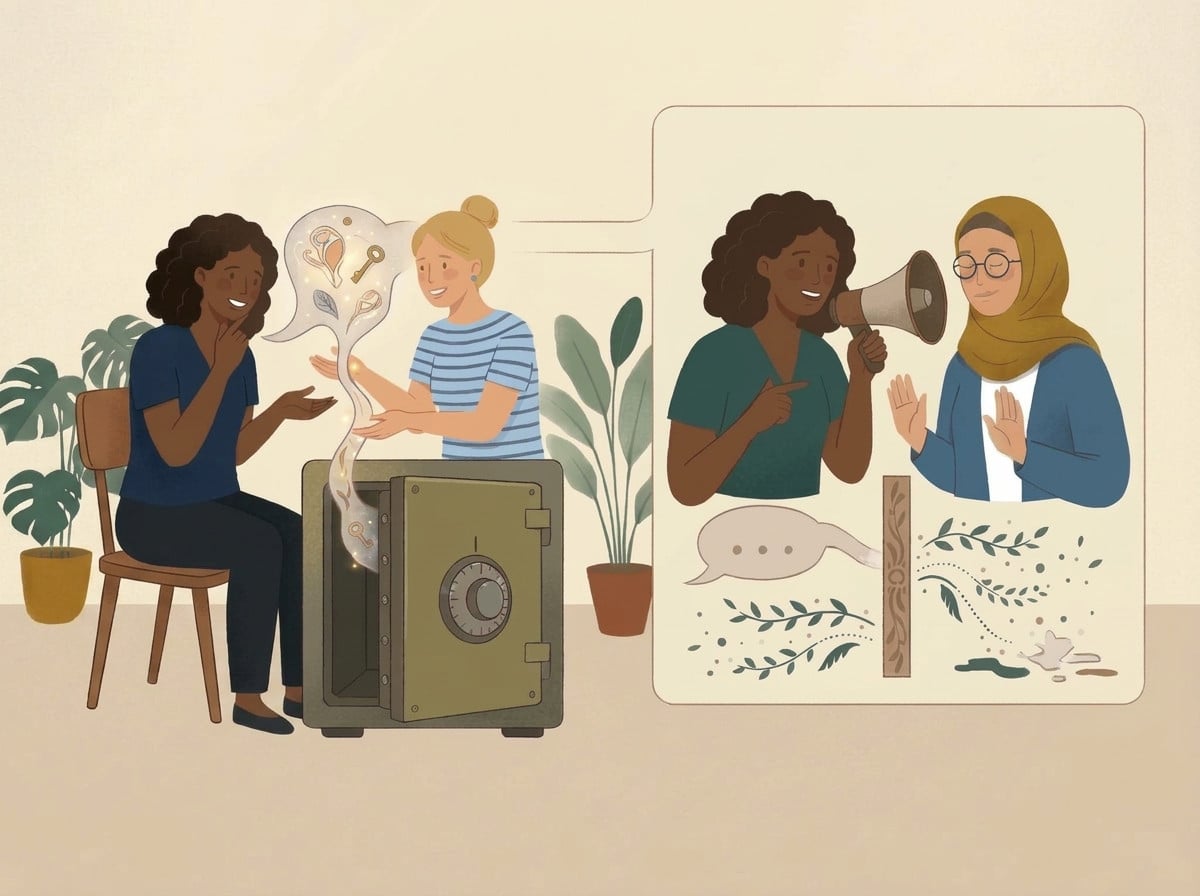
Separate public story from private vault: There is a massive difference between discussing how someone behaved at a wedding and revealing a private struggle they shared in confidence—or a sensitive family matter that isn’t yours to tell. Public life is fair game for observation, private pain is off-limits. If a piece of news would make the subject feel exposed or betrayed to know it was circulating, the conversation stops with you.
Apply the “need-to-know” filter: Toxic gossips broadcast unnecessary details simply because they have them. Before passing along a piece of information, ask a simple question: Does this person actually need to know this, or am I just filling silence with someone else’s business? If the detail serves no purpose beyond shock value or idle filler, keep it in the vault.
Never trade intimacy for cheap currency: One of the fastest ways to erode trust is using someone else’s secret as an icebreaker. When you reveal a relative’s or friend’s private misstep to entertain a third party, you aren’t building closeness—you are advertising that you cannot be trusted with sensitive cargo.
Know when to be a dead end: Every social circle needs people who act as vaults rather than megaphones. Being a trustworthy conversationalist doesn’t mean sitting in rigid silence, it means knowing how to listen with empathy, offer perspective when asked, and let sensitive details quietly die with you rather than forwarding them down the chain.
There is a hard line between public observation and private betrayal. Sharing an observation about how someone acted at a wedding party is normal social processing. On the other hand, revealing a secret someone entrusted to you in a moment of vulnerability is a breach of character.
Tea over coffee
The urge to talk about the people in our lives is symptomatic of belonging to a community. To live among other human beings is to be endlessly fascinated by their triumphs, baffled by their blunders, and invested in their fates.
Marcus Aurelius was right that we should guard our peace of mind and tend to our own character first. Yet Jane Austen – perhaps a more realistic painter of characters – knew that a life without the lively, imperfect, occasionally scandalous symphony of human chatter would be a terribly lonely affair. Perhaps the secret to good conversation isn’t refusing to talk about other people—it is simply talking about them in a way that we wouldn’t be ashamed to have repeated back to us.