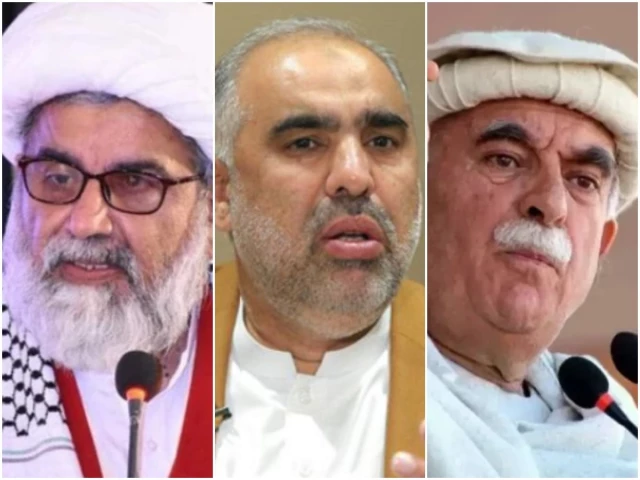
Leader of the Opposition in the Senate Allama Raja Nasir Abbas, PTI leader and former NA speaker Asad Qaiser and Leader of the Opposition in the National Assembly (NA) Mahmood Khan Achakzai. Photos: Express
ISLAMABAD:
The Tehreek-e-Tahafuz-e-Ayin-e-Pakistan (TTAP) on Monday called for a transparent judicial review of the constitutional grounds for imposing governor’s rule and an emergency in Khyber-Pakhtunkhwa (K-P), warning that such governance systems undermine provincial autonomy, the public mandate and parliamentary democracy.
The joint declaration was issued by Leader of the Opposition in the National Assembly (NA) Mahmood Khan Achakzai, Leader of the Opposition in the Senate Allama Raja Nasir Abbas and Pakistan Tehreek-e-Insaf (PTI) leader and former speaker of the NA Asad Qaiser after a consultation on the country’s prevailing “political and constitutional” situation.
On November 7, the Peshawar High Court (PHC) removed all petitions challenging the imposition of emergency and governor’s rule in Khyber Pakhtunkhwa, as well as 3-MPO detentions, from its cause list following a Federal Constitutional Court ruling stripping it of jurisdiction over post-October 12 cases. The move followed the court’s November 5 order barring the PHC from hearing 3-MPO detention cases.
Before that, the PHC had granted bail to 23 PTI workers arrested under the ordinance and sought responses from the governor and provincial assembly speaker over the imposition of governor’s rule.
The opposition alliance maintained that such governance styles must be transparently examined by the judiciary to determine their constitutional validity, stressing that the supremacy of the Constitution, provincial autonomy and parliamentary democracy must be safeguarded.
The declaration also paid tribute to Maulana Fazlur Rehman for his stance on constitutional matters, saying that targeting the dignity and honour of political leaders or their families over political differences was contrary to democratic traditions.
Read: PML-N’s Asif backs twelve new provinces
On the health of the PTI founding chairman and Bushra Bibi, the TTAP demanded that complete medical examination reports be made public without delay.
It also called for immediate implementation of the Supreme Court’s decision to transfer the former prime minister to Shifa International Hospital.
“Imran Khan’s treatment should be ensured in the presence of his personal physicians,” the joint declaration emphasised further.
Moving on to the arrests of several PTI leaders in the aftermath of the long march, including suspended K-P Chief Minister Sohail Afridi and Speaker Babar Saleem Swati, the opposition alliance demanded a clarification from the government.
“Elected public representatives should be produced before the relevant courts,” the declaration underscored, while adding that the practice of arresting political workers and denying them their legal rights “must come to an end”.
“All political workers, including [sisters of Imran Khan] Aleema Khan, Uzma Khan and Noreen Niazi, should be released immediately.”
It said access to courts and the right to seek justice were fundamental constitutional rights of every citizen and must be protected without discrimination.
Also Read: PIMS doctors visit Imran, Bushra
The TTAP concluded that its democratic struggle against political victimisation and unconstitutional measures would continue in light of the prevailing situation.
The TTAP formed a committee on November 5 to facilitate the upcoming All Parties Conference and pledged to launch countrywide protests against what it described as an undemocratic government.
K-P governor’s rule and emergency
On October 11, President Asif Ali Zardari approved Prime Minister Shehbaz Sharif’s advice to impose an emergency and governor’s rule in the province under Articles 232 and 234 of the Constitution, citing a deterioration in the security situation, an increase in terrorist attacks, and what it described as the provincial administration’s failure to cooperate effectively in counter-terrorism efforts.
Under the new arrangement, executive powers were transferred to Governor Faisal Karim Kundi, assisted by an advisory council, while emergency measures were imposed in 12 districts. The PTI rejected the federal government’s position and opposed the move.
The decision followed weeks of tensions between the Centre and the PTI-led provincial administration, alongside negotiations aimed at securing agreement on a joint strategy against terrorism.
The measures resulted in the removal of Afridi and his cabinet from office, with executive authority transferred to the governor.